

How to Ask for More Connection Without Sounding “Needy”
When you’re in a relationship, and you’re really feeling a lack of connection, it can be hard to know what to say. You might feel like you shouldn’t have to say anything, that your partner should just “get it”. You might worry you’re asking for too much. You might feel like you would rather disappear than admit you need more closeness. And you certainly don’t want to feel or sound too “needy”.
It’s not actually “needy” to ask for more connection in a relationship, but it’s understandable to hesitate to voice your needs. Asking for connection can feel shameful, especially if you haven’t learned how to voice your needs and were taught from a young age that expressing them was unacceptable. So what can you do when you’re craving closeness?
Knowing your attachment style helps you create connections in relationships
To get a better idea of how to ask for more connection in a relationship without sounding demanding, dismissive, accusatory, or the dreaded “needy”, it helps to look at your attachment style. Once you better understand how you and your partner are approaching (and struggling with) connection in relationships, you can then work on using healthy attachment behaviors together, so you can each build secure, long-lasting attachments in your relationship.

What is attachment theory?
Attachment theory takes a look at how people behave in close relationships, examining them through the lens of whether a primary caregiver provided (or failed to provide) closeness, safety, love, and nurturing connection in early childhood. While you don’t need to go all the way back to your childhood to build a healthy relationship now, knowing your attachment style is a helpful starting point.
There are four attachment styles, and if you experience any of the three insecure attachment styles, understanding your attachment style (or styles, as some people exhibit different styles in different relationships) can then help you understand what you need to change to create a secure, strong connection in relationships.
Anxious attachment
People with anxious attachment fear abandonment and relationship ruptures, and can come off as needy when they push for connection to the point of criticism, attempted control, and dismissal of their partner’s need for space. They crave closeness but constantly struggle with anxiety over perceived or potential loss of connection.
Avoidant attachment
People with avoidant attachment struggle to feel safe in connection; independence and avoidance feel safer, and they may feel “needy” by even attempting to communicate when they’re craving closeness. The expectations and vulnerability of connection in relationships can feel emotionally overwhelming to the point of feeling threatening, and they can dismiss their partners' needs, making them feel “needy” for wanting any connection at all.
Disorganized attachment
People with disorganized attachment experience a blend of anxious and avoidant behaviors, and often alternate between them. They may crave closeness and feel needy for wanting connection, then quickly feel overwhelmed and threatened by vulnerability and push their partner away the next.
Secure attachment
Secure attachment is a healthy balance between independence and closeness. Secure attachment behaviors avoid neediness by balancing your own needs with the needs of your partner. You don’t chase connections that aren’t rewarding, but you also don’t feel like you need to run away from connections that lead to vulnerability and closeness. When you crave closeness, as a securely attached person, you can voice what you want with an honest, open request.
It’s important to remember that attachment styles are not permanent! You are not doomed to running from love if you have avoidant attachment, and you’re not stuck chasing a feeling of safety that never comes if you have anxious attachment. You and your partner can both develop secure attachment behaviors and use them to create a connection without either of you feeling “needy”.
How can you reach for emotional connection when you’re craving closeness?
There are plenty of sources that give you tips on putting the “spark” back in a relationship, but those guides just tell you what to try, not how to connect with each other without feeling even more separated than before. At Heights Couples Therapy, we want to offer deeper, more meaningful knowledge that can help you and your partner work on the “how” of your connection.

Consider how you ask for what you need
As we said earlier, there’s nothing wrong with asking for what you need, but it is a good idea to be thoughtful about how you ask. “We aren’t doing enough together,” or “You aren’t doing what I need you to,” could easily feel demanding or accusatory to your partner. They also aren’t a clear expression of your needs and wants. What can you do instead?
Choose a good time for a conversation. Pick a time when nobody is rushing, distracted, or upset.
Use “I” statements: “I would like to spend more time together,” or “I have been feeling some distance between us.”
State your needs as relationship goals: “It would feel really good if we could try to have a date night each week.” or “I love it when we cuddle, it’d be great to try to cuddle more often!”
Use validation to help make sharing feel safer
Validation is a way of listening and responding that helps people feel seen, heard, and valued. It is a way to connect to your partner that helps you both feel safe expressing your needs. To validate each other in a conversation, try to:
Use active listening: remove distractions, use body language that shows you’re listening, and give your focus to your partner.
Instead of jumping into problem-solving or trying to correct your partner (even if they have some facts wrong), let them know you’ve heard them by reflecting back to them what they’re saying.
Share what you notice about how they’re feeling, and let them know it’s understandable they feel that way (even if you don’t agree, they feel how they feel, and it’s important to recognize that).
Take turns validating each other. Make sure validation happens before any problem-solving. This dual validation helps make a vulnerable experience feel fair.

Notice when your insecurities are influencing your connection
While you discuss connection in your relationship, pay close attention to how you’re feeling, and ask your partner to do the same. If you feel urges to lean on insecure attachment behaviors, like insisting on a difficult conversation immediately, or downplaying your partner’s attempts to connect, try to accommodate each other while also supporting each other.
If you find yourselves falling into the typical pursuer-withdrawer dynamic, name it. “We are falling into that pattern again. Let’s do something different.”
After you name what’s happening, try to name what you need in the moment. “I need to know that we will be able to work together on this. Let’s pick a time where we can connect more.” “I need to take a break, or plan a time to have this conversation.”

Houston Couples Therapy can help you and your partner build satisfying, secure connection
At Heights Couples Therapy, our compassionate therapists work with couples every day to help them learn secure attachment-based strategies to emotionally reach for connection safely. We want every couple we work with to leave behind the feeling of “neediness” and instead embrace a healthy, enjoyable balance of connection and independence that supports each partner in feeling fulfilled and close.
If you’re looking for Houston couples therapy that prioritizes connection, communication, and relationship satisfaction, Heights Couples Therapy is here for you. Connect with us today to get started with a free consultation, to see how we can help you go from feeling needy to feeling seen, heard, and loved!
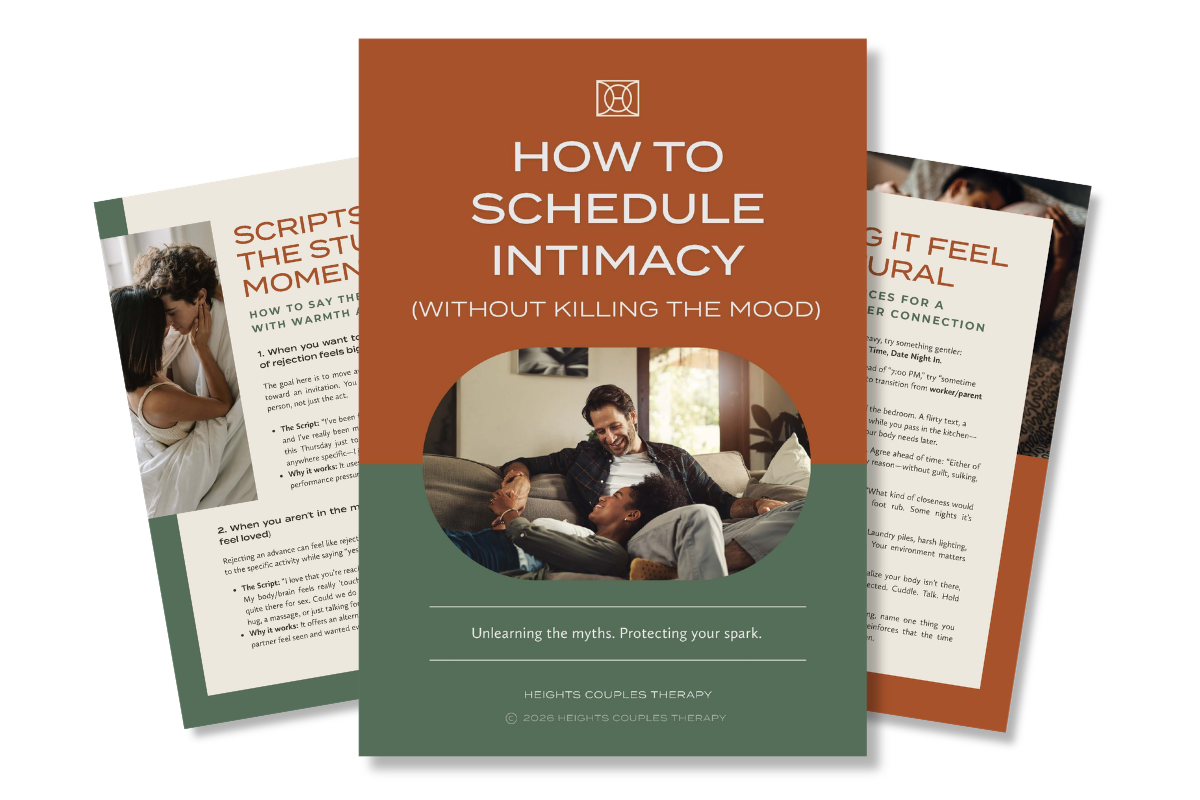
If you want a more structured way to talk about closeness, desire, and making time for each other, download our free guide, How to Schedule Intimacy (Without Killing the Mood). It is designed to help couples move out of the shame-and-pressure cycle and into warmer, more connected conversations.
Sources:
https://headway.co/resources/attachment-based-therapy-techniques
https://www.psychologytoday.com/us/therapy-types/attachment-based-therapy
https://www.aamft.org/AAMFT/Consumer_Updates/Adult_Attachment_Relationships.aspx (Requires login)
https://www.heightscouplestherapy.com/blog/shut-down-during-conflict
https://www.heightscouplestherapy.com/blog/asking-for-connection