

Same Transition, Different Timelines: What To Do When One Partner Is Struggling to Adjust to Parenthood
Adjusting to parenthood is a deeply personal experience, and some partners may find the transition harder than others. Even in strong relationships, it’s common for partners to adjust at different speeds.
When one parent hasn’t fully settled into the responsibilities of caregiving, it can leave the other feeling overwhelmed or alone. Understanding why this happens can build empathy. Knowing what to do next can help you move forward as a team.
Below, we’ll explore the most common reasons partners struggle to adjust, along with practical steps and when to consider reaching out for more support.

What are the most common reasons partners struggle to adjust to parenthood?
#1: Gender Norms and Societal Expectations
In many cultures, mothers, or birthing parents, are expected to take on the bulk of caregiving responsibilities, which can lead to the assumption that they should “naturally” adjust more quickly to their role. On the other hand, fathers, or non-birthing parents, may feel societal pressure to maintain their traditional roles as providers, leaving little room for them to fully engage in caregiving tasks (Lamb, 2010). This can lead to an unequal distribution of responsibilities and a slower transition into shared parenting.
What can you do?
Have a gentle, honest conversation about the expectations of parents you each observed growing up. Use “I” statements and speak about general roles; try not to get personal.
Identify what “shared parenting” means for your family.
Redistribute a few predictable tasks to help build new habits (e.g., bedtime, bottles, daycare drop-offs).
Seek professional support if conversations keep becoming defensive without resolution, resentment is building, you struggle to redistribute routine tasks, or one partner is feeling chronically blamed or misunderstood. A skilled couples therapist can help you rewrite expectations and create a more balanced, modern caregiving plan.
2. Susceptibility to Stress or Mental Health Struggles
The transition to parenthood can be emotionally and physically taxing for both parents. However, some individuals may be more vulnerable to mental health challenges, such as postpartum depression or anxiety, which can hinder their ability to adjust (Stewart et al., 2003). Fathers or non-birthing parents, too, can experience stress and these same mental health challenges that may not always be recognized, which can affect their engagement and ability to share responsibilities (Cabrera et al., 2000).
What you can do
Start from curiosity rather than criticism: “I’ve noticed you seem stressed. How are you feeling?”
Make small, functional shifts: short breaks, therapy appointments, extra support from family/friends. Don’t worry about whether you’re doing things the “right way”. Instead, look at what’s happening, and what will help.
Reassure the struggling partner that it’s not their fault, and that things don’t have to stay this way. Instead, offer support in finding resources or ways that will help.
Seek professional support if: one or both of you are consistently irritable, withdrawn, or overwhelmed, symptoms last more than a couple of weeks, you or your partner is having thoughts of harming yourself or your baby, or mental health concerns interfere with bonding with the baby or daily functioning. A perinatal therapist can help assess what’s happening and offer treatment options to help you navigate the postpartum period.

Make it stand out
3. Limited Previous Parenting Experience
Previous experience with children may also influence how quickly someone adjusts to parenthood. A parent who has cared for children before, perhaps even as a babysitter or caregiver for friends and family, may feel more confident and prepared for the role, while someone with less experience may need more time to adjust (Pleck, 2012). Previous experience can also inform how reasonable our expectations are, or are not. This is especially true for first-time parents who may be overwhelmed by the many new tasks and responsibilities.
What you can do
Label this as simply a skills gap rather than a motivation issue or character flaw. Approach the gap with a “let’s learn something new” attitude.
Practice caregiving tasks together (bathing, swaddling, feeding) so it doesn’t feel like one partner is “in charge.”
Allow the less experienced partner to have their learning curve with becoming a parent, and normalize mistakes. Choose 1–2 caregiving tasks they can own consistently to build confidence in the beginning.
Seek professional support if: the less-experienced partner avoids caregiving entirely, attempts to share tasks lead to conflict, or one partner feels like the “default parent” and is burning out. A therapist can help you explore these barriers and dynamics in your relationship without blame.
4. Work Demands & External Pressures
The demands of work, finances, and external pressures can also affect how parents adjust to their new roles. A partner who is juggling work demands or other external stressors may struggle to find the time or mental energy to engage fully in parenting responsibilities (Palkovitz, 2002). This can create a sense of imbalance, where one parent feels overwhelmed while the other is less involved in parenting tasks.
What you can do:
Talk about the difference between capacity and commitment, and what that means for each partner.
Review schedules together to find predictable times a partner who works outside the home can take the lead on parenting.
Adjust expectations to reflect each partner’s realities while still aiming for teamwork.
Seek support if: the working partner becomes defensive when asked for more involvement, the stay-at-home or primary parent feels invisible, unsupported, or exhausted, and/or your division of labor feels unsustainable long-term. A therapist can help you rebuild balance and clarify shared values as you navigate work responsibilities and caregiving roles.

Houston parents can find relationship support at Heights Couples Therapy
When partners are adjusting to the major changes of parenthood at a different pace, it can strain even the strongest relationships. At Heights Couples Therapy, we support Houston parents in sustaining their relationship throughout their parenting journey. We can help you remember that you’re a parenting team, supporting you as you work on parenting and relationship challenges together.
If you and your partner could use support in sustaining your connection as you take on the tremendous task of parenting, we’re here for you. Contact us today for a free consult, to see how we can help you to strengthen your relationship as you embrace parenthood.
Free Guide for New Parents: Turn Arguments into Opportunities
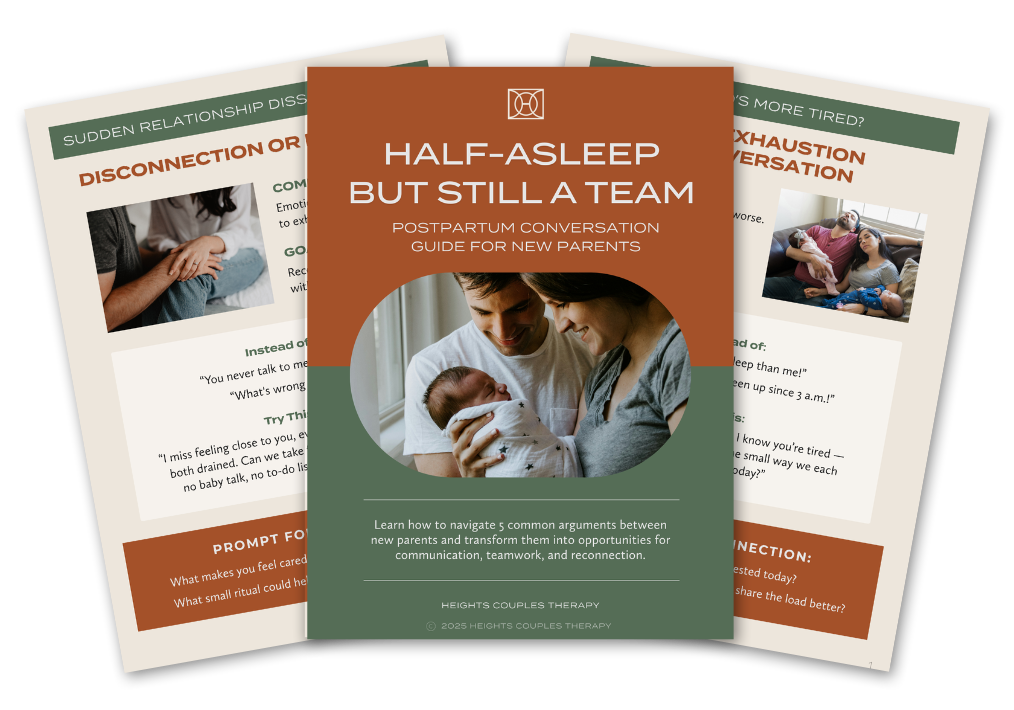
Learn how to navigate the 5 most common arguments between new parents, with helpful prompts to transform struggles into opportunities for connection and teamwork.