

When One Partner Wants to Leave: How Discernment Counseling Helps Mixed-Agenda Couples
Maybe you’ve had it. You’re tired of the same old arguments, the defensiveness, the cycles of pursuing and withdrawal. You’re not seeing a way forward, and you know that you’re not sure it’s worth the effort of continuing to try, but you haven’t walked out the door yet.Maybe you’re still invested, but you can tell your partner is considering divorce. They’re pulling away, talking about separation, and aren’t even willing to argue anymore. You want to salvage the relationship, but they don’t see the point. They haven’t left yet, but they’re more out than in.
When one partner wants a divorce, and the other wants to work on the relationship, it can feel impossibly hard to know what to do next.
When one partner is ready to leave, what can a couple do?

Whether you’re a partner considering leaving or you’re partnered with someone who is considering divorce, you know the choices here aren’t easy. You’ve spent a lot of time building this relationship, you are worried about the potentially exhausting process of lawyers, financially separating, and you may have children to consider. You’re dreading conversations with friends and family if you do split, and you’re dreading continuing the relationship that is causing so much pain.
You still care, even if one of you is ready to be done. If this were a simple decision, you or your partner would have made it already.
Are you wasting time by staying? Are you wasting a good relationship (that needs some effort) if you leave? How can both of you find answers to these questions in a way that offers clarity, not more confusion?
Sometimes the Hardest Part Is Simply Staying in the Conversation
When one partner is leaning toward repair and the other is unsure whether the relationship can continue, conversations can quickly become emotionally overwhelming.
One person may feel desperate to reconnect.
The other may feel emotionally exhausted, guarded, or afraid of giving false hope.
Without realizing it, couples can get pulled into cycles where both people leave the conversation feeling even more disconnected.
But difficult conversations do not automatically mean the relationship is beyond repair.
Often, what matters first is learning how to slow the cycle down enough for both people to feel heard, understood, and emotionally safe enough to keep talking honestly.
If you are struggling to navigate painful or high-stakes conversations, we created a free guide called: How to Stay Connected When You Disagree
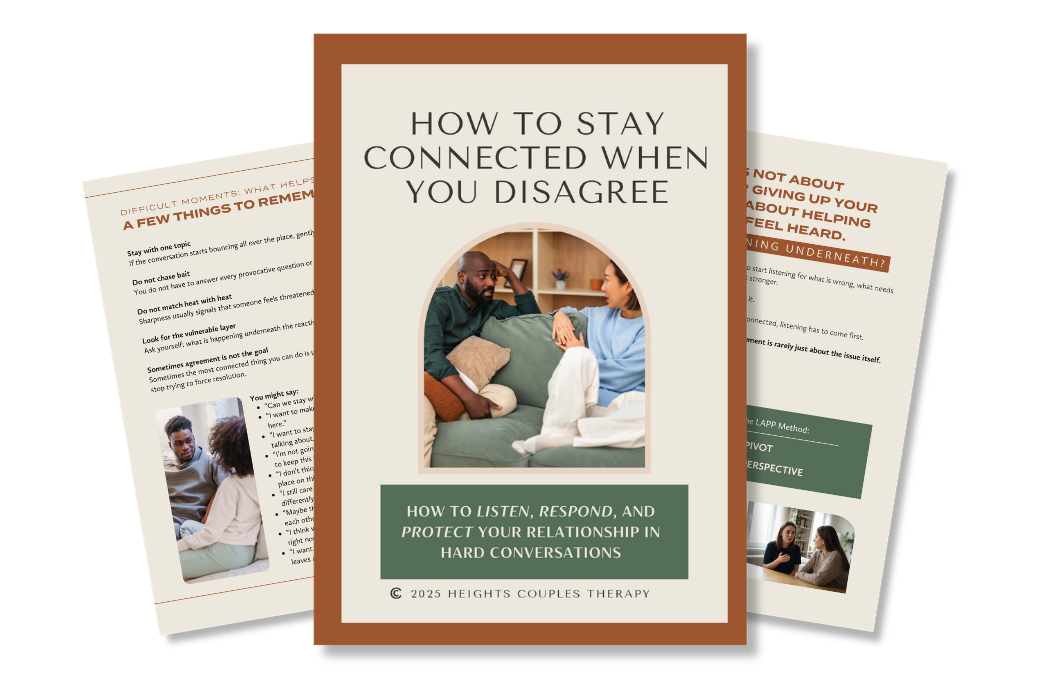
Inside, you’ll learn:
How to stay emotionally connected during difficult conversations
A simple framework for listening and responding without escalating conflict
Ways to slow reactive cycles before conversations completely break down
How to communicate differences without losing emotional safety
Discernment therapy can help mixed-agenda couples cut through the noise and make decisions that make sense
You know that your relationship isn’t sustainable as-is, but you and your partner aren’t on the same page about reconnection versus separation. You need to clearly lay out your options, opinions, and experiences, and you know you need to hear what your partner is thinking and feeling, but that can be hard to do together. Tension, disagreements, insecurities, and resentments often stand in the way of the two of you deciding together what’s best.
You know that couples counseling, where you both work together to solve relationship challenges, isn’t likely to be productive, since one partner wants to divorce. Mixed-agenda couples need another option: discernment therapy.
What is discernment therapy like?
Discernment therapy is set up not to help couples reconcile, but to find clarity and help each partner decide what they need to do next. It typically takes a few sessions, but some couples are able to decide after one session, or use a maximum of five sessions to decide.
For each partner, this is a space to individually consider their thoughts and feelings about the relationship with the support of an experienced relationship therapist. Most of the time in each session will be spent individually with the therapist, weighing choices and gaining insights.
From there, you’ll be able to share with your partner honestly and openly about what you’re willing to do next, and what you want to do next. You’ll also have a chance to hear their conclusions, and you’ll make thoughtful, carefully considered choices on what you want to do next.

How can discernment therapy help when you want a divorce?
You’re ready to divorce, which may be the best option, but you’ve hesitated so far. Your discernment therapy counselor can help you dig into the reasons you’re ready to go, and can help you consider how you and your partner have played a part in your relationship struggles. You and your therapist will explore the “why” behind your readiness to go, not to change your mind, but to help you fully understand what’s going on. As you consider your reasons, you’ll also have a chance to consider your other options: taking more time to decide what to do or reconciliation. While you might feel resistant to considering anything else, it can help you to think through what other options would look like. It can clear up hesitations and give you a path forward you can pursue with confidence. You will either reconfirm your choice of divorce with more clarity or find another option that works for you. Your therapist will ask thoughtful questions and reflect back to you what they’re hearing, helping you understand what choice is truly best for you.
How can discernment therapy help when your partner wants a divorce?

It can feel hopeless and heartbreaking when one partner wants a divorce, and you want to work on your relationship. You’re likely looking at all the love and connection you have had, and leaning hard on the potential for a happy future to sustain your willingness to keep trying.
In discernment therapy, your therapist will help you consider the “why” behind your desire to work on your relationship, and guide you in exploring the parts you and your partner have played in your relationship coming to this point. This can give you more clarity and help you with the next step: considering your other options. You may be resistant to fully exploring what divorce or waiting to decide might look like, but by carefully considering all your options, you’ll be able to either reconfirm that your choice of pursuing reconciliation is right for you or discover that you may want to make another choice. You’ll feel more confident in what you want, and can use that confidence to make your choices.
Discernment therapy gives you a space to talk things over and make individual decisions
Mixed-agenda couples that work through discernment therapy sessions can come to confident conclusions about what each partner wants, and then can come together in a safe, supportive space to honestly share what they’ve decided.
While you may not both have the same choices going forward, you’ll be able to calmly and considerately let each other know what you will do next. You’ll have support in this moment, whatever you choose, to be heard and seen, and to hear your partner out. Even if the conclusions you come to are difficult and distressing, you’ll be clear in what you both want, making your next choices easier to understand.

What’s the next step after discernment therapy?
The next steps depend on your individual choices arising from discernment therapy.
For a partner who has come to the conclusion that divorce is their choice, talking to lawyers and making choices about how separation will look is the next step; if the other partner also wants divorce, the same next steps apply, but if one partner still wants to pursue the relationship, individual therapy may help that partner through the divorce process. For partners who both decide to wait to choose, pursuing individual therapy may be a worthwhile choice. Finally, for partners who both conclude that reconciliation is what they want, couples therapy is a helpful starting place for creating repair and connection.
Heights Couples Therapy offers discernment therapy, couples therapy, and individual relationship therapy to help couples who are trying to decide what to do next. Our supportive counselors can help you cut through the emotional tangle that has kept you from being able to make clear choices, and can help you and your partner with whatever next steps are best for you.