

How to Find the Right Couples Therapist in Houston: A Practical Guide
This guide is designed to help you make an informed, confident decision in choosing a Houston couples therapist. Whether you’re navigating constant conflict, emotional distance, a major life transition, or a crisis point in your relationship, the right couples therapist can help you slow things down, understand what’s happening beneath the surface, and begin rebuilding connection.

Searching for a local couples therapist can feel overwhelming, especially when your relationship already feels strained. If you’re in Houston and looking for help, you may be facing dozens of profiles, conflicting advice, and uncertainty about what actually makes therapy effective.
Below, we’ll walk through what to look for in a couples therapist, what questions to ask, and how to know if a therapist is the right fit for you.
Why Does Choosing the Right Couples Therapist Matter?
Couples therapy is not just about communication tips or compromise. At its core, effective relationship therapy helps couples understand patterns: the emotional cycles that keep repeating despite best intentions.
Research consistently shows that outcomes in couples therapy depend heavily on a good working relationship with your therapist. This breaks down into some key factors:
The therapist’s training and approach
The emotional safety created in sessions
Whether both partners feel understood and supported
The therapist’s ability to work with conflict without taking sides
Not all therapy models are equally effective for couples, and not all therapists are trained specifically in relationship work. That’s why choosing the right couples therapist is a critical first step.
What should you look for in a Houston couples therapist?
Look for Specialized Training in Couples Therapy
One of the most important factors to consider is specialization. Many therapists offer couples therapy, but fewer have advanced training in relationship-specific models. Couples work is complex. It requires understanding attachment, emotional regulation, conflict dynamics, and how two nervous systems interact under stress.
When searching for a couples therapist in Houston, look for clinicians who specialize in couples or relationship therapy and who clearly state their approach.
Evidence-Based Models to Look For
Some of the most researched and effective approaches include:
At Heights Couples Therapy, we primarily use Emotionally Focused Therapy (EFT), an evidence-based model backed by decades of research. EFT focuses on emotional bonds, helping couples move out of distress cycles and into safer, more connected patterns.
If a therapist cannot clearly explain how they work with couples or what guides their interventions, that’s a sign to ask more questions.

Look Beyond “Communication Skills”
Many couples seek therapy because they feel unheard, misunderstood, or stuck in the same arguments. While communication matters, lasting change usually requires addressing why communication breaks down in the first place, then rebuilding communication skills and patterns.
Effective couples therapy explores:
Emotional triggers and unmet attachment needs
Pursue–withdraw or demand–distance cycles
Fear, vulnerability, and protective responses
How past experiences shape present reactions

Ask the Right Questions Before You Commit
Before scheduling your first session, it’s not just okay, it’s important to ask questions! A good couples therapist welcomes curiosity and transparency.
Here are a few helpful questions to ask or see if you can find on their online profiles:
What training do you have specifically in couples therapy?
What therapy model do you use with couples?
How do you work with high-conflict relationships?
What happens if one partner feels more hesitant about therapy?
How do you handle moments when emotions escalate in session?
Pay Attention to Emotional Safety
One of the most overlooked but essential aspects of couples therapy is emotional safety. Both partners should feel heard without being blamed, supported without being “sided against,” and able to express vulnerability without fear of judgment. If a therapist quickly aligns with one partner, minimizes the other’s experience, or allows sessions to escalate without containment, it can increase distress rather than reduce it.
A skilled couples therapist knows how to slow conversations down, regulate intense moments, and help each partner understand (not attack) the other.
When Neurodivergence Is Part of the Relationship
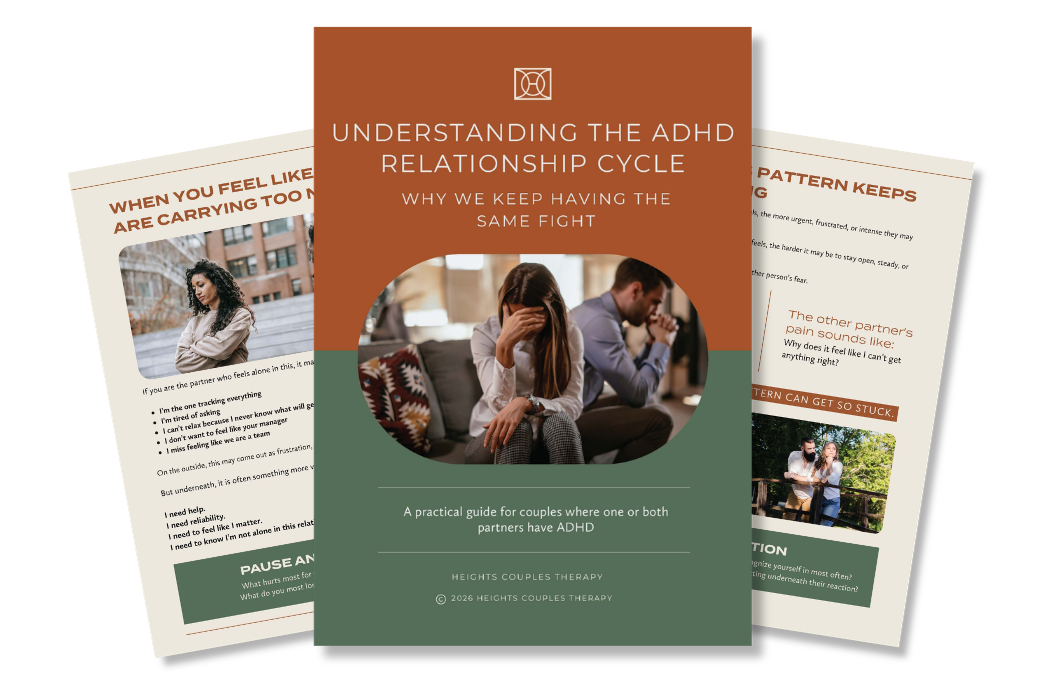
ADHD can create relationship dynamics where one partner feels chronically alone while the other feels like they are constantly failing.
Understanding the cycle underneath the conflict can make a major difference.
What are some red flags for couples therapists?
While most therapists are well-intentioned, there are signs that a couples therapist may not be the right fit:
Taking sides or labeling one partner as “the problem”
Allowing sessions to become emotionally unsafe
Offering generic advice without exploring deeper patterns
Avoiding conflict rather than helping couples navigate it
Lacking clear training in couples-specific therapy models
Trust your instincts. Feeling challenged is normal; feeling dismissed or unsafe is not.

Consider Therapy Location and Format in Houston
Houston is a large, diverse city, and logistics matter more than many couples realize.
When choosing a couples therapist, consider:
Location: Are sessions accessible from your home or workplace? (Many couples in The Heights prefer local providers.)
In-person vs. online: Do you feel more grounded meeting face-to-face, or is virtual therapy more practical?
Scheduling flexibility: Does the therapist offer times that realistically work for both partners?
Why We Prefer In-Person Couples Therapy
At Heights Couples Therapy, we intentionally serve couples in The Heights and greater Houston area, offering online therapy when it’s the most accessible option. However, for couples work, we strongly prefer in-person sessions whenever possible.
Couples therapy often involves slowing down emotional reactions, noticing subtle patterns, and staying present during difficult conversations. Being physically in the room together creates a protected, intentional space, separate from daily distractions, where the relationship itself becomes the focus.
In-person sessions also allow the therapist to track emotional cues, regulate moments of intensity, and support both partners in real time. Simply showing up together, in a space designed for reflection and connection, is often an important part of the work.
When online therapy is needed, we approach it thoughtfully. But whenever possible, we believe meaningful relationship change happens best when couples carve out sacred time and space to be fully present with one another.
What If Your Partner Is Hesitant About Therapy?
It’s common for one partner to be more motivated than the other. This doesn’t mean therapy won’t work. A well-trained couples therapist knows how to address skepticism without pressure and create safety for reluctant partners. In some cases, individual therapy focused on relationship dynamics may also be an appropriate starting point.

Looking For Couples Therapy in Houston That Truly Helps?
Choosing a couples therapist is an investment in your relationship’s future. The right therapist doesn’t just help you talk more, they help you understand each other differently.
If you’re looking for couples therapy in Houston or The Heights, working with a relationship specialist trained in evidence-based couples therapy can make a meaningful difference. At Heights Couples Therapy, we help couples move out of painful cycles and into stronger emotional connection using trusted, research-backed approaches.
If you’re ready to explore whether couples therapy is right for you, we invite you to reach out and learn more about how we work.