

How to Stop the Same Fight From Happening Again: A Therapist’s Guide for Houston Couples
It’s not uncommon for couples to find themselves stuck in the same old fight over and over again. The topic varies, but the cycle stays the same. Whether you’re stuck arguing over finances, scheduling, parenting, household work, priorities, whatever the subject, you can’t seem to get out of the conflict. This cycle is adding stress to an already busy life, making it harder for you to connect.
You know your relationship isn’t where you want it when it comes to communication and conflict, and you both want to change, but you might not be sure where to start. As couples therapists in Houston who use Emotionally Focused Therapy (EFT) techniques to help partners recognize conflict cycles, we understand your frustration, and we have put together this guide to help you and your partner use emotional awareness, validation, and connection to break the cycle of repetitive, exhausting couples' arguments.
The same fight over and over: how pursuer-withdrawal cycles work
When couples have the same fight over and over, they are often stuck in a type of relationship pattern called a pursuer-withdrawer cycle. This concept is outlined in EFT, with each partner taking a role that aligns with their attachment style. They are either the pursuer, usually with anxious attachment behaviors, or the withdrawer, usually with avoidant attachment behaviors.
The pursuer wants an immediate response to avoid anxiety
The pursuer wants to address disagreements, challenges, or issues right now, to prevent deep anxiety. They want to be heard, and they want to know exactly how and when change will happen. They pursue connection with their partner during conflict, and can become anxious, distressed, and even harshly critical and angry if their pursuit of connection isn’t immediately responded to. In the fight vs. flight dynamic, a pursuer is the “fight” option.
The withdrawer wants space to avoid anxiety
The withdrawer is more of the “flight” option when it comes to conflict. They need time to digest a disagreement on their own, and in persistent conflict cycles, they will pull away from their partner during a disagreement more and more. They may shut down, deflect, minimize, or literally leave the room during a conflict to prevent deep anxiety, and they will avoid any discussion or attempts to connect.
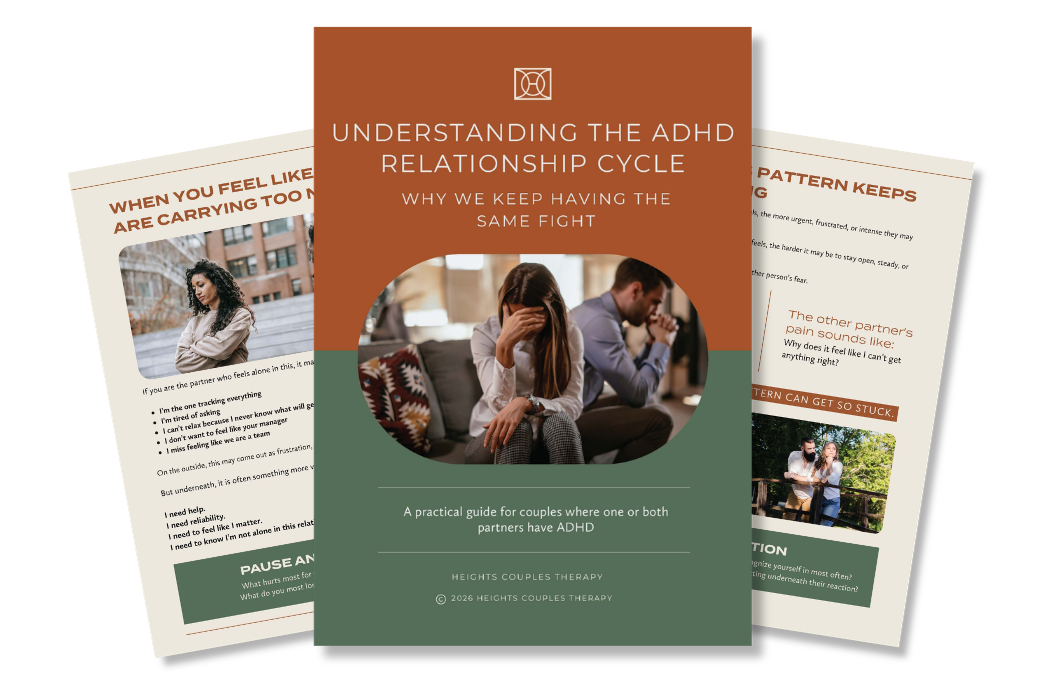
Sometimes repeated conflict is not just about communication. For neurodivergent couples especially, recurring arguments can become deeply emotional cycles of overwhelm, shame, urgency, and disconnection.
→ Download our free guide: Understanding the ADHD Relationship Cycle
Steps to help you transform your communication with a Houston EFT couples therapist

1. Set firm boundaries on when and where the conversation happens
That fight you keep having has probably ruined more than its fair share of dinners, weekend mornings, and holidays. It pops up all the time, and because it plays into major fears around abandonment and safety, it can drain you and derail even the happiest day.
One of the best ways to transform your communication is to set aside specific times for conflict resolution. Create some ground rules that work for both of you, like not having any arguments via text message, only having serious discussions or disagreements after work, not before, taking time to write down your thoughts before talking, or saving your biggest disagreements for your regular couples counseling sessions at Heights Couples Therapy.
2. Take breaks to stop cycles from repeating
When you notice you’re both becoming overwhelmed by emotions during a conversation, and you’re falling back into your old pursuer-withdrawer roles, take a break. Set a time limit, and seek out calming activities that help you both, separately, so you can come back to a more balanced place to continue the conversation. This gives the withdrawer some breathing room and helps the pursuer by making it clear that time with them is a priority.
3. Consider the feelings that are creating the cycles
Take a look at your emotional state during that same old argument. Are you sad, anxious, angry, scared? Do you feel ignored, or like you’re under a microscope? Do you feel like you have to be perfect, or like you’re the only one putting in effort?
Your emotions are a main driver of your behavior. For a pursuer, the underlying fear of rejection or abandonment drives their pursuit of connection, even when it causes their partner distress. For a withdrawer, the pressure of conflict and the underlying fear that they cannot meet expectations or withstand the emotions that might come up during conflict can be so overwhelming that it makes them want to hide, avoid, or get away.
Recognizing what feelings you’re both experiencing and the roles you fall into because of these feelings can help you stop, take a moment, and experience your emotions. You can then communicate them to each other, and find a space of understanding.
4. Listen and validate
Pursuers and withdrawers struggle to listen to each other. The pursuer uses high-pressure communication to feel safer in the connection, and the withdrawer shuts down to avoid feeling unsafe in conflict.
When you have a better idea of what you’re feeling, and you’ve set aside time to have difficult conversations, it can feel safer to listen. Get rid of distractions, sit together, really look at each other, find a comfortable balance between connectedness and having space, and take turns expressing yourself. Don’t launch into blame, minimizing, or fix-it demands.
Talk about how you feel. Both of you can try to hear what the other person has to say (it can be helpful to use “I statements, like “I feel” or “I notice,” instead of “You always” or “you shouldn’t”), and try to recognize that each of you has your reasons for feeling the way you do.
Even if you don’t fully agree, try to recognize your partner’s distress, earnestly acknowledging that the way they feel makes sense. “I can see you’re hurting, and I can understand why someone in your position would feel that way,” can go a long way. When both of you put real effort into listening, even if you don’t resolve the conflict, you create a connection that doesn’t feel unstable or suffocating. You work together, in a loving way, to try to understand.

5. Create connection opportunities outside of conflict
Couples stuck in conflict cycles can end up feeling so disconnected that they struggle to enjoy intimacy and closeness even when not fighting. Quality time can be hard to come by when one is chasing and demanding connection, and the other is running from the pressure.
Alongside firm boundaries around when and where disagreements and challenging conversations can happen, set goals for time together as a couple. Think back to things you used to enjoy together or dreams you had together, and try to enjoy them again. This closeness can help you and your work together to stop having the same fight, which can make this closeness easier, too. As you make communication changes that help the pursuer know they’ll have time set aside to be heard and the withdrawer knows they won’t be pushed to figure out a sudden conflict, you make it easier to enjoy moments of connection together.

6. Commit to couples communication therapy
When you’re in entrenched roles in your relationship and you’re stuck in the same conflict cycle again and again, it can be hard to find the emotional space to help each other change. This is a great time to look for communication help in Houston from a couples therapist who specializes in EFT for couples. Your therapist will prioritize both of you, and your relationship, helping you work through the steps needed to stop having the same fight again and again.
Couples communication therapy with an empathetic therapist at Heights Couples Therapy can help you both feel safe to open up about your feelings, to step out of the roles, and to try a new way to navigate conflict. It can feel really vulnerable to let go of old patterns that helped you feel safe, but your therapist can provide a safe space for you and your partner to work on your relationship, making room for openness, validation, accountability, and new ways to connect.
Book a free consultation today to see how couples therapy in Houston can help you break out of toxic communication cycles and find connection, instead of the same fight over and over.