

How to Bounce Back After a Breakup: What to Expect and How to Move On
Healing after a breakup takes time, but most people move forward by processing emotions, creating distance, rebuilding routines, and reconnecting with themselves.

Houston Therapy for Breakups to Heal and Have Better Future Relationships
Going through a breakup is tough and can leave us feeling lost and overwhelmed. It's a time filled with emotional highs and lows, and figuring out how to move forward might feel impossible. That's where individual therapy can be a game-changer as you heal and recover from the end of a relationship. In this post, let's explore how therapy can help you get back on your feet emotionally.
Why Breakups Feel So Hard
Breakups don’t just end a relationship. They disrupt something much deeper.
Even when a relationship wasn’t healthy, or you can logically understand why it needed to end, your emotional system doesn’t always catch up right away. You can know it wasn’t right and still feel the loss intensely.
That’s because relationships aren’t just about compatibility. They are built through attachment, routine, shared meaning, and identity.
When a relationship ends, you’re not only losing a person. You’re also losing:
The version of yourself that existed in that relationship
The routines and rhythms you built together
The future you had imagined
The sense of emotional safety or familiarity
For many people, this creates a kind of emotional disorientation. It can feel like your mind is trying to make sense of something your body is still reacting to.
This is part of why breakups can feel so consuming. Your system is trying to process a loss that is emotional, psychological, and even physical at the same time.
Why Can’t I Move On From My Last Relationship?
If you’re someone who is naturally reflective, you might expect that understanding the relationship should help you move on more quickly. But insight and emotional resolution are not the same thing.
You can clearly see your patterns, recognize what didn’t work, and still feel deeply attached. That’s because awareness happens in the mind, while attachment lives in the nervous system.
Still, you may also feel the pressure to “figure out what happened” quickly.
You may want clarity:
Was it me?
Why do I keep ending up in similar relationships?
What should I have done differently?
While reflection is important, it’s often difficult to see your patterns clearly in the immediate aftermath. When emotions are still active, your perspective can shift from day to day:
One day you may feel certain it wasn’t right
The next, you may question everything and romanticize the relationship
This isn’t a lack of self-awareness. It’s part of being in the middle of the experience rather than outside of it.
Patterns tend to become clearer with:
Emotional distance
Nervous system regulation
Time and perspective
Trying to force answers too quickly can sometimes lead to oversimplifying or blaming yourself in ways that aren’t actually accurate.
Breakup Recovery Timeline
There isn’t a single timeline for healing, but many people move through phases that look something like this:
Early stage (first few weeks):
Shock, emotional swings, difficulty focusing, urges to reconnect
Middle stage (weeks to a few months):
More reflection, rumination, questioning, beginning to see the relationship more clearly
Later stage (months and beyond):
Gradual acceptance, rebuilding identity, increased emotional stability, openness to new experiences
Grieving a relationship is not a linear process. You may move back and forth between these stages. What matters more than speed is whether you’re allowing the process to unfold rather than trying to rush yourself out of it.

Navigating Love and Self-Discovery Post-Breakup: Jamie’s Story
After every relationship, Jamie found herself moving in with her partners almost immediately. The whirlwind romances felt right at the time; the immediate cohabitation always seemed to work, or so she thought. Looking back, Jamie realized that her relationships often went from zero to full speed in a heartbeat, a pattern she'd repeated four times, cohabiting with three.
Recently, Jamie's latest relationship ended abruptly, leaving her in a fog of confusion. She'd been researching covert narcissism and empaths, worried she might be the culprit in her relationship struggles. Discussions with psychotherapists revealed a different story—Jamie was more emotionally reliant on others than narcissistic. This revelation prompted Jamie to seek reassurance from friends and family, but everyone was just as surprised by the breakup.
With no closure in sight and tangled in cognitive dissonance, Jamie decided it was time to reach out to a professional. Her goals in therapy were clear: she wanted to identify her cognitive blind spots and find closure from this relationship. Additionally, she recognized a pattern of consistently 'giving' too much, which pop psychology often labels as an "empath problem."
Through therapy, Jamie hoped to better understand her own needs and boundaries. She aimed to embrace self-discovery, becoming more aware of the dynamics in her relationships and how her codependent tendencies might be impacting them. Therapy would offer her a path to clear away the confusion and help her build healthier, more balanced relationships in the future.

How Can Therapy Help You Move On After a Breakup?
1. Understanding and Managing Your Emotions
Therapy shines when it comes to helping you become more in tune with your emotions. After a breakup, it's normal to feel everything from anger to sadness and confusion. Relationship counseling for divorce and breakups helps you identify these emotions and process them instead of shoving them down. When you understand your emotional responses, healing becomes possible.
Jamie’s story highlights the importance of understanding and managing emotions, especially in the aftermath of a breakup. When relationships end, emotions can become overwhelming, ranging from confusion and sadness to frustration and anger. Therapy plays a crucial role in helping individuals like Jamie process and decode these complex feelings.
For Jamie, her whirlwind approach to relationships and her emotionally reliant tendencies often clouded her emotional clarity. She tended to dive headfirst into relationships, seeking security and validation through her partners rather than within herself. This often left her with a cloud of uncertainty and emotional chaos whenever things ended.
In therapy, the first step in managing emotions is acknowledging and naming them. Jamie learned to identify her feelings more precisely—distinguishing between sadness due to loss, anger at unmet expectations, and confusion over blurred boundaries. By talking through her experiences with a therapist, she began to understand her emotional triggers and patterns.
The therapist guided her to explore these feelings without judgment and helped her comprehend why she might react a certain way. Jamie discovered that her need for immediate connection and cohabitation was partially rooted in a fear of abandonment and an intense need for belonging. Recognizing this was a pivotal moment in her emotional journey, as it allowed her to address the core issues rather than the symptoms alone.
Once emotions are understood, managing them becomes the focus. Jamie learned practical strategies to handle her emotions, like mindfulness exercises and deep-breathing techniques to soothe anxiety and stress. Regular journaling was introduced to help her track emotional shifts and understand them in the context of daily events. These tools empowered her to navigate emotional turbulence with greater ease and resilience.
Moreover, therapy encouraged Jamie to set healthy boundaries in future relationships. Understanding her emotions meant she could communicate her needs more effectively, helping her maintain balance and avoid the fast-paced intensity of her previous relationships.
Overall, the path to emotional understanding and management is deeply personal but universally transformative. For Jamie, it's about regaining control over her emotions and crafting a narrative that focuses on self-awareness and growth. Through therapy, she's building a foundation for healthier relationships and a more grounded sense of self, allowing her to trust in the reality of her experiences and find closure from the past.
2. Breaking Unhealthy Patterns
Often, breakups highlight patterns we've experienced before. Individual therapy can still focus on relationships in that it works to uncover these patterns and helps you address the deep-seated issues that may have contributed to the breakup. This makes it easier to avoid repeating these patterns in future relationships.
Jamie’s journey through therapy also focused heavily on breaking the unhealthy patterns that had become ingrained in her relationship dynamics. Throughout her dating history, Jamie had consistently moved rapidly from meeting someone to living together, a pattern that seemed to work until it didn’t. These patterns, while familiar, often set the stage for future heartbreaks and confusion.
In therapy, Jamie was encouraged to reflect on the roots of these patterns. She began exploring why she felt compelled to dive deep into relationships so quickly. This introspection revealed some eye-opening insights: Jamie realized that her actions were driven by an underlying fear of abandonment coupled with a strong desire for validation and security from her partners. By understanding her motivations, Jamie could see how these patterns were setting her up for repeated cycles of instability and dependency.
Once these patterns were identified, the next step was working towards breaking them. Jamie's therapist helped her develop strategies to slow down and establish healthier pacing in new relationships. This included recognizing red flags and addressing them early on, rather than becoming fully enmeshed and then trying to unravel the mess later.
Learning to set boundaries was another crucial strategy. With guidance, Jamie practiced how to communicate her needs clearly and assertively, ensuring that both she and her partner maintained their individuality while nurturing the relationship. By doing so, she aimed to break free from the cycle of losing herself in each relationship.
To support this transformation, Jamie also examined past relationships to identify consistent patterns that led to their downfall. This reflection provided valuable lessons on what to avoid and what to cultivate in future partnerships. With this clear understanding, Jamie was equipped to make intentional choices rather than falling back into habitual behaviors.
Therapy also introduced her to healthier relationship dynamics, such as focusing on mutual respect and shared growth rather than dependence. Jamie practiced being more self-reliant, developing her sense of self-worth independent of her relationship status. This shift helped her prioritize her well-being, paving the way for connections based on equality and mutual support.
By breaking these unhealthy patterns, Jamie is now more prepared to cultivate relationships that enrich her life, rather than repeating the cycles of the past. Therapy provided her with the tools to create a balanced approach to love and connection, empowering her to embrace future relationships with confidence and clarity.
3. Building Resilience and Confidence
Therapy can boost your emotional strength by focusing on your strengths and past successes. This leads to greater self-confidence and empowerment—key tools for facing future challenges and nurturing better relationships.
For Jamie, building resilience and boosting her confidence were essential components of her therapeutic journey. After experiencing several intense relationships that ended in confusion and emotional turmoil, Jamie realized that regaining her confidence and emotional strength was vital to her healing process.
In therapy, the focus on resilience and confidence began by recognizing Jamie's inherent strengths. Her therapist encouraged her to reflect on past experiences where she had overcome challenges, highlighting her capability to handle adversity. This practice helped Jamie see herself not as a passive participant in her relationships but as an active agent capable of making positive changes.
One key strategy in building resilience was developing a toolkit of coping mechanisms. Jamie learned how to manage stress and emotional setbacks through practical techniques like mindfulness and self-care routines. By consistently applying these strategies, she became better equipped to handle negative emotions and situations with a clear, focused mindset.
To bolster her confidence, Jamie also worked on setting and achieving small, realistic goals. Whether it was pursuing a hobby, taking on a new challenge at work, or simply spending time alone without seeking constant validation, these goals helped her build a sense of accomplishment and autonomy. Achieving these goals reinforced her confidence in her ability to thrive independently.
Additionally, Jamie learned the importance of positive self-talk and reframing negative thoughts. Her therapist guided her in identifying self-critical beliefs and replacing them with affirmations that reflected her true worth. This shift in mindset was crucial for Jamie, allowing her to approach relationships from a place of self-assurance rather than insecurity.
Building a support network outside of her romantic relationships was another vital step. Jamie nurtured friendships and connections where she felt valued and supported. This network served as both a source of encouragement and a reminder of her worth beyond her relationship status.

Over time, Jamie's newfound resilience and confidence transformed how she approached relationships. Instead of seeking immediate immersion, she now takes the time to understand her own needs and boundaries before diving in. This careful, thoughtful approach empowers her to choose partners who respect and value her independence, laying the groundwork for healthier, more fulfilling connections.
Ultimately, therapy helped Jamie reconnect with her inner strength, equipping her with the resilience and confidence to navigate life's challenges with grace. By embracing these qualities, she is not only prepared to face future relationships with renewed optimism but also to cultivate a deeper sense of self, unshaken by trials.
4. Improving Communication Skills
While therapy is often associated with relationship issues, it's also great for honing personal communication skills. Through your sessions, you'll learn to express your feelings more clearly—a skill that helps in building better relationships down the line.
For Jamie, improving her communication skills was vital in reshaping how she interacted within relationships. Historically, her pattern of quickly moving in with partners often meant important conversations about needs and expectations got lost in the rush. Enhancing her communication skills became a cornerstone of her therapeutic journey to forge stronger, more transparent connections.
Therapy provided a safe space for Jamie to practice articulating her feelings and thoughts effectively. One focus was on using "I" statements—expressing her experiences without casting blame. This approach helped Jamie convey her needs without inciting defensiveness in others, fostering more open and understanding dialogues.
Jamie also learned to slow down and truly listen, a skill she practiced in her sessions and with friends. Active listening became a powerful tool, enabling her to understand her partners’ perspectives better and respond thoughtfully, rather than reacting impulsively.
Role-playing exercises in therapy further honed her communication skills, preparing her for real-world interactions. Whether negotiating relationship boundaries or addressing conflicts, these practices boosted her confidence to speak openly and constructively.
Strengthened communication skills empowered Jamie not only in romantic aspects but in all her relationships, enriching her personal and professional life by fostering respect and mutual understanding.
5. Long-Term Emotional Wellness
The benefits of therapy extend beyond just getting through a breakup. As you get better at managing your emotions, you'll likely see improvements in overall mental health, like decreased anxiety and a greater ability to build strong, positive relationships.
Beyond immediate relationship recovery, Jamie’s therapeutic work centered on cultivating long-term emotional wellness. A sustainable approach to mental health ensured that she wasn't just addressing symptoms of her recent breakup but also fostering inner growth that would support her lifelong.
Jamie focused on maintaining her emotional wellness by consistently engaging in practices that nurtured her mental health. Regular therapy sessions became a staple, offering her continued guidance and support, while activities like meditation and journaling helped her stay attuned to her emotional state.
An essential part of Jamie's emotional wellness was learning to embrace self-care as a priority rather than a luxury. By scheduling time for activities that brought her joy—like reading, hiking, or exploring new hobbies—she built a fulfilling life that didn’t solely center around her romantic relationships.
Jamie also developed a routine for checking in with herself, asking reflective questions about her well-being and feelings on a regular basis. This habit allowed her to address any emotional challenges early on, preventing them from escalating into larger issues.
The skills and insights Jamie gained in therapy laid the foundation for a balanced life. By understanding and honoring her emotions, enhancing her communication, and prioritizing her well-being, she is well-equipped to handle whatever life throws her way. This commitment to her long-term emotional health ensures that Jamie approaches every new day and relationship with stability and strength.
Making Therapy Part of Your Healing Journey
Choosing to dive into therapy after a breakup shows great strength. If this sounds like a fit for you, look for a therapist you feel comfortable with. The right therapist can make a significant difference in your healing process. Remember, everyone’s journey to healing is unique, so finding the right kind of support is crucial.
Breakups are never easy, but individual therapy offers support and structure to help you heal better. By tuning in to your emotions, you can build resilience and prepare yourself for healthier future relationships. Seeking help is a powerful step, and therapy might be just the thing to guide you through this challenging time.
If you're curious about learning more about therapy for relationships, read more about how we help in individual therapy.
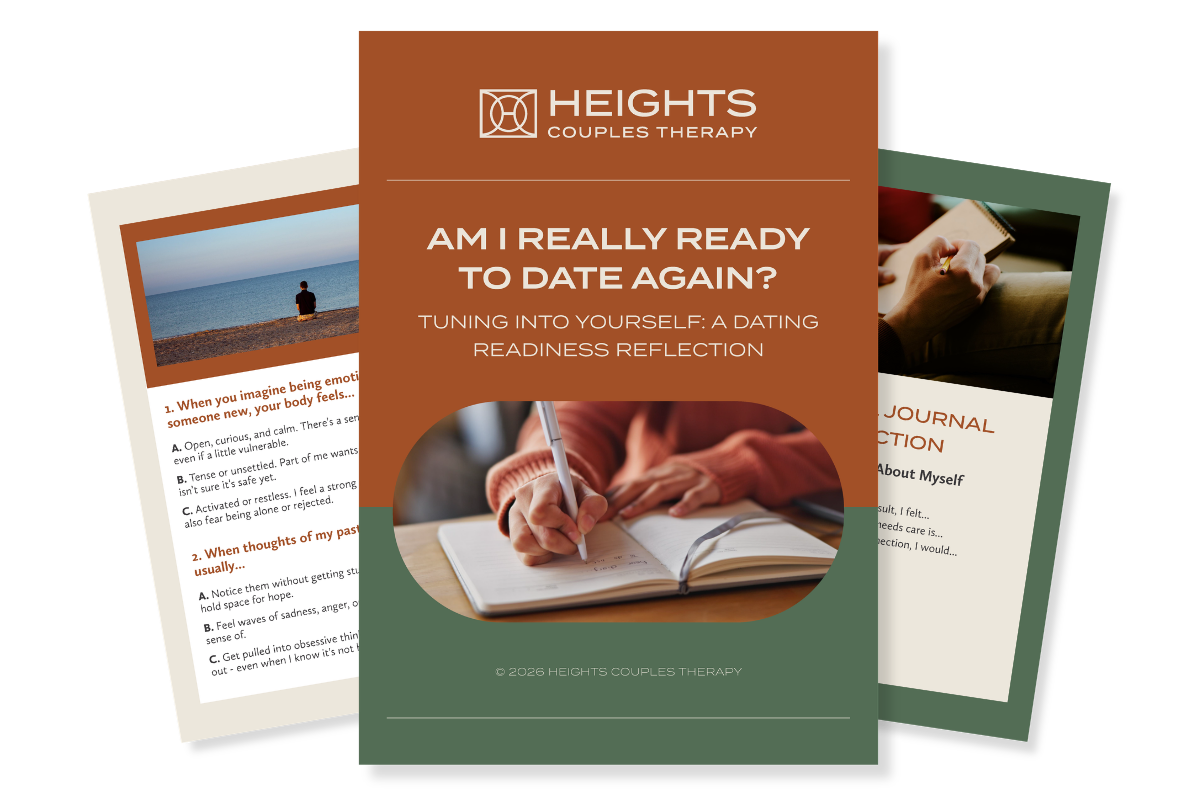
If you’ve read this blog and you’re wondering whether you might be ready to date again, we have a perfect resource for you. Check out “Am I Really Ready to Date Again?” and download your copy today!
Frequently Asked Questions About How to Heal After a Breakup
-
There’s no fixed timeline for healing after a breakup. Some people begin to feel more stable within a few weeks, while for others it can take several months or longer. The timeline often depends on the depth of the relationship, the circumstances of the breakup, and the level of support you have. Healing tends to happen gradually, not all at once.
-
It’s common to feel pain even when the breakup was necessary. Emotional attachment, shared routines, and the future you imagined together don’t disappear just because the relationship ended. You can logically know something wasn’t right while still feeling the loss deeply on an emotional level.
-
After a breakup, your mind often tries to make sense of what happened. This can show up as replaying conversations, wondering what you could have done differently, or focusing on positive memories. These thoughts are part of how your brain processes loss and attachment, especially when the relationship was meaningful.
-
There’s no “right” timeline, but it can be helpful to wait until you feel more emotionally steady and less focused on your past relationship. Dating too soon can sometimes be a way to avoid processing the loss. Taking time to reconnect with yourself first often leads to more grounded and intentional choices moving forward.
Consider downloading our resource, Am I Really Ready to Date Again?
-
It depends on the relationship and where you are emotionally. In many cases, creating some distance initially can help you process the breakup more fully. Friendship may be possible later, but it usually requires clear boundaries and enough emotional space to avoid reopening the attachment.
-
Individual Therapy can provide a space to process the relationship, understand patterns, and work through the emotional impact of the breakup. It can also help you make sense of confusing or conflicting feelings and support you in moving forward in a more intentional way.